NOTE: In 2009, I have posted "Translations of 4P or Bazi Terms" article. It becomes one of the most read message. People found it helpful to the understanding of the so-called "10 Gods" or transformation stars, especial those who have studied with different Bazi teachers using different terminologies. The article is a subset of the Appendix section of my "4P Bootcomp" video course. Here I post the whole Appendix with more information below.
TRANSLATIONS OF 4P OF BAZI TERMS
There are no commonly agreed translations of 4P terms. Different schools or teachers translate 4P terms according to his/her personal preferences. There are three major rules used in translations:
1. Literal translations: This simply gives a faithful and very often, horrible (in terms of culture shock) translations of the terms. For examples, “
shi-shen” is translated as “eating god”, “
qi-sha” becomes “7-killings”, “
shang-guan” becomes “hurting officials or officers” and the likes. Problem with literal translations is that it may bias student perceptions towards certain terms as “
bad” or negative because it sounds horrible. In reality, every one of the “
10 gods” or ‘transformation stars” (my terminology) can be positive or negative depending on the composition of the 4P chart. Another common misconception is the ubiquitous uses of the term "
god" in 4P, like "useful god" (
yong shen), "enmity god" (
chou shen) and the like, making 4P sound "
religious" when it is actually more statistical and logical in nature.
2. Pin-yin translations: This gives a transliteration of the 4P terms like “
shi-shen”, “
zheng-guan” and etc. It takes some time to get used to these foreign terms. But it is great when you go back to the original Chinese texts or switching teachers/school.
3. Translation based on interpreted meanings: This translates the 4P terms based on the understanding of the translator. For example,
shi-shen and
shang-guan are translated as “output” stars. But different people have different understanding of the terms, so the translations can sometimes be confusing and shocking as well. Good translations under this should be “
value-free” or NOT “
value-laden”. It should also give meanings that are faithful or close to the original meanings of the terms. The translated terms should not influence the perception of the readers and students.
4.
Mixing of all of the above
The following examples are the common translations of 4P's "
10 gods" or "transformation stars":
 |
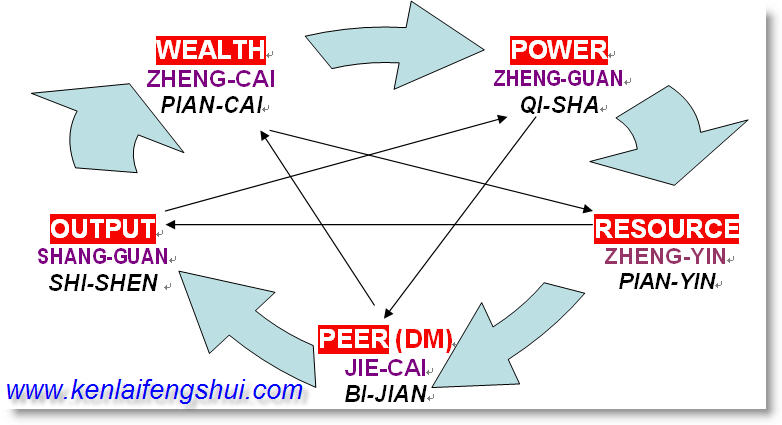
Diagram showing the productive cycle of 10 transformation stars (blue or hollow arrows for productive cycle and black arrows for controlling cycle). If you understand the dynamics of this diagram, you already know 60%+ of 4P. Most 4P operations revolves around this diagram.
|
10 GODS OR TRANSFORMATION STARS TRANSLATIONS
Jie-cai 劫财
Ken: JC, +peer ("+" stands for polarity "yang", not necessarily means positive!)
Others: rob wealth, competitor, unfriendly parallel, contender-star, unfriendly partner
Bi-jian 比肩
Ken: BJ, -peer ("-" stands for polarity "yin", not necessarily means negative!)
Others: friend, collegue, unfriendly parallel, friend-star, friendly buddy
Zheng-cai 正财
Ken: ZC, +wealth
-- direct wealth, wealth, proper wealth, earned wealth, earned property, property-star, possession
Pian-cai 偏财
Ken: PC, –wealth
Others: indirect wealth, wealth, unbecoming wealth, unexpected wealth, unexpected property, windfall star, godsend wealth, unexpected possession
Zheng-yin 正印
Ken: ZY, +resource
Others: direct resource, resource/education, proper resource, main funds, proper care, mother-star, willingly nourished
Pian-yin 偏印
Ken: PY, –resource
Others: indirect resource, resource/education, unbecoming resource, unexpected funds, unbecoming care, guardian star, unwillingly nourished
Shang-guan 伤官
Ken: SG, +output
Others: hurting officer, intelligence/aspirations, drastic ouput, actor-star, offending-star, harsh output
Shi-shen 食神
Ken: SS, –output
Others: eating god, intelligence/aspirations, gracious output, artist-star, food-star, emotional IQ
Zheng-guan 正官
Ken: ZG, +power
Others: direct officer, power/status, proper power, discipline, angel star, the obedience
Qi-sha 七杀
Ken: QS, –power
Others: 7-killings, power/status, unbecoming power, unbecoming discipline, evil star, the stern
STEM AND BRANCH INTERACTIONS
Five Stem Combinations (天干五合)
-- combinations
Stem Clashes (天干相剋 )“ke”
-- clashes and countering
Six Branch Combinations (地支六合) ”he”
-- combinations
Six Branch Clashes (地支六冲) “chong”
-- clashes
Branch 3-Meeting (地支三会) “san hui”
-- frame, directional combinations, regional combinations
Branch 3-Unity (地支三合) “san he”
-- 3-harmony, triangular branch combinations, 60-degrees combinations
Half 3-Unity (半地支三合) “san he”
-- semi/half 3-harmony
Branch Six Harms (地支六害) “hai”
-- harms
Earthly Branch Six Damages (地支六破) “po”
-- destruction
Branch 3-Penalties (地支三刑) “san xing”
-- punishment
Branch Self-penalties (自刑) “zi xing”
-- self-punishment
MISCELLANEOUS TERMS
Favorable element (“Yong Shen”) 用神
-- “useful god”: the element that a chart needs most
Unfavorable element (“Ji Shen” ) 忌神
-- “annoying god”: the element that hurts a chart most
Supporting element (“Xi Shen” ) 喜神
-- “happy god”: the element that nurtures the favorable element
Vengeful element (“Chou Shen” ) 仇神
-- “vengeance god”: the element that nurtures the unfavorable element
Trivial element (“Xian Shen” ) 閑神
-- “trivial god”: the element that does not affect Day-master much
Transformation platform (“Fa Shen”) 化神
-- “transformation god”: the element needed for combination and transformation to take place
4P PROFILES/ CHART TYPES
Extreme strong 专旺格
w/ Extreme wood曲直格, Extreme fire炎上格, Extreme earth稼墙格,
Extreme metal從革格, Extreme water 潤下格
-- ultra-strong
Extreme weak 從弱格
w/ Follow wealth 從财格, Follow sha (power) 從杀格, Follow offspring從兒格, Follow the powerful 從势格
-- ultra-weak
Follow the strong 從强格
-- follow strength
Qi-transformation 化氣格
JIA-JI EARTH transformation甲己化土格
YI-GENG METAL transformation乙庚化金格
BING-SHEN WATER transformation丙辛化水格
DING-REN WOOD transformation丁壬化木格
WU-GUI FIRE transformation戊癸化火格
-- qi-transformation
My personal bias is trying to make the translated terms as neutral as possible, so as not influencing the reader's perception. Each of these 10 "stars" or "gods" can be positive or negative depending on the combination of the natal chart and luck periods.
I do not mean other translations are not as "
good" or "
horrible" as mine. Translations reflect the worldviews, command of the Chinese language and mental conditions of the translators.
Ken Lai
© 2011 Ken Lai, all rights reserved.
Video Correspondence Courses: (click for details)
“Advanced Visual Form Feng Shui” w/23 hr. HD video
“Visual Form Feng Shui” w/13 hr. HD video
“Applied Bazi: Sickness Forecasting and Management” w/33 hr. HD video
“Destiny/Luck Mgmt. 1: Forecasting and Decision Support” w/32 hr. HD video
“Destiny/Luck Mgmt. 2: Basic Bazi Therapy w/18 hr. HD video
“Destiny/Luck Mgmt. 3 w/ Advanced Bazi Therapy w/18 hr. HD video
“Feng Shui Toolbox: Sha-qi, Health/Wealth and Career” w/ 7 hr. HD video
“Period 7/8 FS Toolkit w/ Advanced Flying Star techniques” w/ 6 hr. HD video
“Practical Date-Selection Methods (incl. XKDG) w/ 12 hr. video
“Practical Imperial Qi-Men-Dun-Jia 4G” w/ 12 hr. video
“Professional Imperial QMDJ 4G” w/ 21 hr. video
“EZ QMDJ series: Astrology, Date/Task Selection, Annual Luck/ FS” w/ 3 hr. HD
“EZ QMDJ Advanced Feng Shui” with 4 hr. HD video
“Daoist Talismans for Feng Shui/Blessing” w/ 24 hr video
“Practical Door Feng Shui for Wealth” w/ 3 hr. video
“4-Pillars Forecasting Bootcamp+ 2019 edition” with 18 hr. video
http://www.kenlaifengshui.com